
An Ultrasonic Lace Machine is designed to process lace, synthetic fabrics, and technical textiles using high-frequency ultrasonic vibrations. Unlike conventional textile processing equipment that relies entirely on mechanical cutting or traditional sewing, this machine uses ultrasonic energy to support cutting, edge sealing, bonding, perforating, stripping, and molding. It helps manufacturers produce clean edges, reduce fabric fraying, and improve the consistency of finished textile products.
For textile manufacturers, lace producers, garment accessory suppliers, and technical fabric processors, ultrasonic technology offers a flexible solution for handling materials that require accurate processing and professional finishing. By combining ultrasonic processing with adjustable operating speeds and customized molds, manufacturers can adapt production to different product designs and material specifications.
The AT-304L Extended Ultrasonic Lace Machine is one example of this equipment. It features a servo motor control system, an extended working structure, and a customizable mold design. With a working speed of 5–20 meters per minute and a processing width range of 60–200 mm, it is designed to support various continuous textile processing requirements.
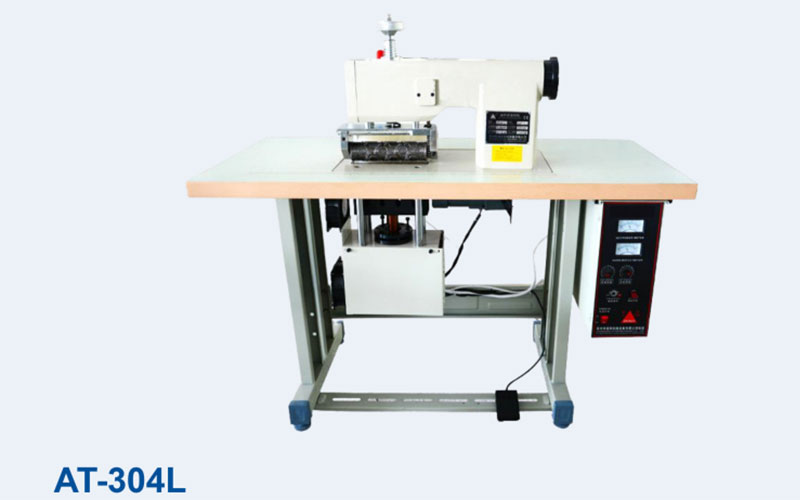
What Is an Ultrasonic Lace Machine?
An ultrasonic lace machine is specialized equipment that uses ultrasonic vibrations to process suitable textile materials. It is particularly useful for synthetic fabrics and lace products that require precise edges, decorative patterns, or consistent finishing.
In conventional fabric cutting, blades separate materials through direct mechanical contact. Depending on the material structure and cutting conditions, the edges may require additional finishing to prevent loose fibers or unraveling. Sewing can provide reinforcement, but it may add production steps and change the appearance or thickness of the finished product.
Ultrasonic processing offers an alternative for compatible materials. High-frequency vibration generates localized energy at the processing point. Under appropriate pressure and operating conditions, this energy can soften or fuse certain thermoplastic fibers, helping create a clean cut and sealed edge.
The results depend on the fabric composition, thickness, structure, mold design, and processing parameters. Synthetic textiles containing suitable thermoplastic fibers are generally more appropriate for ultrasonic sealing than materials that cannot be softened or fused by ultrasonic energy.
An ultrasonic lace machine can therefore help manufacturers improve processing consistency while reducing reliance on some traditional finishing operations.
How Does an Ultrasonic Lace Machine Work?
Understanding the working principle of an ultrasonic lace machine helps manufacturers determine whether the equipment is suitable for their production requirements.
1. Material Feeding and Positioning
The fabric is positioned within the machine’s working area and guided through the processing section. Proper material alignment helps maintain consistent cutting width and pattern placement.
For continuous production, stable feeding is particularly important because variations in fabric tension or positioning can affect edge quality and finished dimensions.
2. Ultrasonic Vibration Generation
The ultrasonic system generates high-frequency mechanical vibrations and transfers them to the processing tool. When the tool contacts a compatible synthetic fabric under suitable conditions, localized energy is produced at the contact area.
This energy supports material separation and, where the fabric composition allows, the fusion of fibers along the processed edge.
3. Cutting and Edge Sealing
During processing, the machine can cut the material while helping seal its edges. This combined operation can reduce loose threads and minimize fraying in suitable thermoplastic textiles.
The final result depends on the selected mold, material characteristics, operating speed, pressure, and ultrasonic settings. Manufacturers should conduct material trials before beginning large-scale production.
4. Customized Pattern Processing
Different lace products require different widths, outlines, and decorative patterns. A customizable mold allows the machine to accommodate specific product shapes and processing requirements.
This flexibility is useful for manufacturers producing multiple textile designs or supplying customers with customized lace components.
Key Features of the AT-304L Extended Ultrasonic Lace Machine
The AT-304L Extended Ultrasonic Lace Machine combines adjustable production speed, a customizable mold system, and an extended working structure to support flexible textile manufacturing.
Threadless Ultrasonic Sealing
One of the main advantages of an ultrasonic lace machine is its ability to create sealed edges without conventional stitching for suitable materials. This can help manufacturers achieve a neat appearance while reducing the need for additional edge-finishing operations.
Threadless processing is particularly valuable when visible stitching would affect the appearance of lace or decorative textile components.
Multiple Processing Functions
The AT-304L supports several processing operations, including cutting, sealing, bonding, perforating, stripping, and molding. Combining these functions in one machine can simplify production arrangements for manufacturers handling different textile products.
However, the exact operations available for a particular material depend on the installed tooling, mold configuration, and machine setup.
Servo Motor Speed Control
The machine operates at an adjustable working speed of 5–20 meters per minute. This range allows operators to adjust material movement according to the product design, fabric characteristics, and required finishing quality.
Lower speeds may be appropriate when testing unfamiliar materials or processing intricate patterns, while higher speeds may support suitable products in established production conditions.
Extended Working Structure
The extended structure is designed to provide greater flexibility when processing continuous textile materials. The specified processing width range is 60–200 mm, making the machine suitable for a variety of narrow fabric products and lace components within this range.
Manufacturers should confirm the actual usable width for their particular product and mold before purchasing.
Customizable Mold Design
Mold customization allows the machine to accommodate different product shapes and processing requirements. This is important for manufacturers producing decorative lace, shaped textile components, or specialized fabric accessories.
Providing product drawings, material samples, dimensions, and expected production volumes can help the supplier evaluate the appropriate mold configuration.
Technical Specifications of the AT-304L
The following table summarizes the main technical parameters of the AT-304L Extended Ultrasonic Lace Machine.
| Parameter | Specification |
|---|---|
| Input power supply | 110V/220V, 50/60Hz |
| Power | 1.5–2 kW |
| Working speed | 5–20 m/min |
| Processing width range | 60–200 mm |
| Mold | Customizable |
| Air pressure | 0.5–0.8 MPa |
| Machine dimensions | 1200 × 540 × 1180 mm |
These specifications provide an initial reference for evaluating equipment suitability. Before ordering, manufacturers should confirm the required electrical configuration, compressed-air supply, installation space, mold design, and production capacity with the supplier.
It is also advisable to test representative fabric samples to establish suitable operating parameters and verify the quality of the finished edges.
Applications of an Ultrasonic Lace Machine
An ultrasonic lace machine can support multiple textile manufacturing applications, especially where accurate processing and clean edges are important.
Lace Manufacturing
Lace products often feature intricate patterns and delicate structures. Ultrasonic processing can help manufacturers cut compatible lace materials into specific shapes while minimizing loose fibers along processed edges.
This capability is useful for decorative lace components used in garments, lingerie, and other textile products. The suitability of the process should be confirmed for each lace construction.
Garment Accessories
Garment accessories frequently require consistent dimensions and an attractive finish. An ultrasonic lace machine can process suitable synthetic textile components used in decorative trims, shaped fabric pieces, and other apparel accessories.
For manufacturers producing multiple designs, customized molds can help maintain consistent shapes across production batches.
Synthetic Fabric Processing
Synthetic fabrics are an important application area because many thermoplastic fibers can respond to ultrasonic energy under appropriate conditions.
Depending on their composition and construction, materials such as polyester and certain nylon fabrics may be suitable for ultrasonic cutting and edge sealing. Testing is necessary because coatings, fiber blends, thickness, and fabric density can influence processing results.
Technical Textiles
Some technical textile products require repeatable dimensions, clean edges, or specialized perforation patterns. An ultrasonic lace machine equipped with suitable tooling may support selected applications involving synthetic textile components.
Manufacturers should evaluate the required mechanical properties and environmental performance of the finished product before adopting ultrasonic processing.
Continuous Textile Production
For businesses processing continuous rolls or repeated lengths of compatible fabric, adjustable speed and stable material feeding can support a more consistent workflow.
The AT-304L’s specified speed range of 5–20 m/min provides flexibility for different production conditions, although actual output will depend on product complexity, setup time, material handling, and quality requirements.
Benefits of Using an Ultrasonic Lace Machine
Improved Edge Quality
Ultrasonic cutting and sealing can produce neat edges on suitable synthetic fabrics. Reducing fraying and loose threads may improve product appearance and decrease the need for secondary finishing.
Reduced Dependence on Sewing
For applications that require only cutting and edge sealing, ultrasonic processing may eliminate the need for conventional stitching along the processed edge. This can simplify production and create a different visual finish.
It does not replace sewing in every application, particularly when a product requires structural seams, stretch characteristics, or specific reinforcement.
Flexible Product Customization
Customizable molds make it easier to accommodate different patterns, widths, and product shapes. This is beneficial for manufacturers serving customers with varied specifications or frequently changing product designs.
More Consistent Processing
Servo motor speed control and appropriate tooling can help maintain repeatable processing conditions. Consistency is especially important for products that require uniform dimensions and appearance across large production batches.
Potential Production Efficiency Improvements
Combining several compatible processing operations in one machine may reduce material transfers and simplify production arrangements. The actual productivity improvement depends on the existing workflow, material properties, and the number of operations that can be combined successfully.
How to Choose the Right Ultrasonic Lace Machine
Selecting the right ultrasonic lace machine requires more than comparing power ratings and working speeds. Manufacturers should consider the following factors before making a purchasing decision.
Material compatibility: Identify the fabric’s fiber composition, thickness, density, and any coatings or laminations. Confirm that ultrasonic processing can achieve the desired result without damaging the material.
Processing width: Check that the machine can accommodate the required product dimensions. The AT-304L specifies a width range of 60–200 mm.
Production speed: Estimate the required output and determine whether the machine’s 5–20 m/min speed range meets production targets under realistic operating conditions.
Mold requirements: Discuss the product’s dimensions, patterns, tolerances, and drawings with the manufacturer to determine whether a custom mold is needed.
Installation conditions: Verify the available power supply, compressed-air capacity, and installation space. The AT-304L requires 110V or 220V power at 50/60Hz and air pressure of 0.5–0.8 MPa.
Sample testing: Before committing to mass production, request a trial using actual production materials. Evaluate edge appearance, dimensional accuracy, processing stability, and the durability of the finished product.
Conclusion
An Ultrasonic Lace Machine provides textile manufacturers with a flexible way to process compatible lace, synthetic fabrics, and selected technical textiles. By using ultrasonic vibration for cutting and edge sealing, it can help reduce fraying, improve finishing quality, and simplify selected production operations.
The AT-304L Extended Ultrasonic Lace Machine combines a 1.5–2 kW power rating, adjustable speeds of 5–20 m/min, a 60–200 mm processing width range, and customizable molds. Its extended structure and servo motor control system make it an option for manufacturers seeking adaptable equipment for continuous textile processing.
For businesses evaluating this machine, the most important step is to match the equipment configuration to the intended material and finished product. Confirming specifications, testing samples, and selecting suitable molds can help establish whether the AT-304L meets specific production requirements. With the right setup, ultrasonic processing can support cleaner finishing, consistent product quality, and more efficient textile manufacturing.