
Modern garment manufacturing is increasingly moving toward automation, seamless construction, and more refined decorative finishing. Lace is no longer used only as a traditional decorative material. It can also form part of the functional and structural design of underwear, sportswear, outerwear, and other textile products. To apply lace accurately and consistently, manufacturers need equipment that can control material feeding, bonding, positioning, and processing speed. A Lace Applying Machine provides a specialized solution for these requirements.
A Lace Applying Machine is designed to apply lace, trims, decorative strips, or similar textile components onto fabric through controlled bonding and feeding processes. It can help manufacturers reduce dependence on manual application while improving positioning accuracy and production consistency. Depending on the machine configuration and bonding method, it can be used for invisible lace bonding, exposed bonding, decorative effects, and glue overflow processes.
The AT-102 Lace Applying Machine, for example, is designed for high-precision lace bonding and decorative finishing. Its applications include seamless underwear, outdoor apparel, technical garments, and other clothing products requiring lace application or exposed bonding effects. It uses upper and lower roller feeding and provides an adjustable operating speed of 0–150 mm/s.
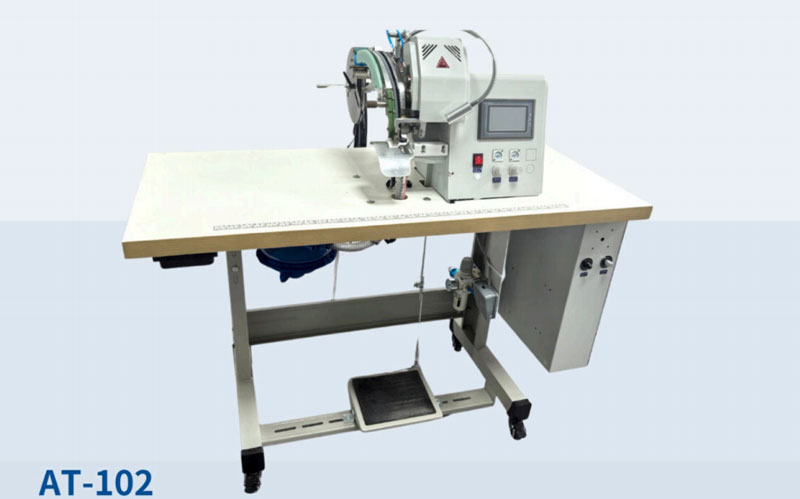
What Is a Lace Applying Machine?
A Lace Applying Machine is specialized textile equipment used to attach lace or other narrow textile materials to a fabric surface. Instead of relying entirely on manual positioning and sewing, the machine provides controlled feeding and bonding during production.
The machine can work with suitable adhesives or bonding materials to create a connection between lace and the base fabric. Depending on the garment design, the bonding area may be hidden beneath the lace or intentionally exposed as part of the finished appearance.
The basic process involves feeding the fabric and lace through the machine, maintaining their relative positions, applying the required bonding material, and pressing the materials together. The exact process depends on the machine configuration, adhesive, fabric, lace structure, and desired finished effect.
For garment manufacturers, the main value of this equipment is not simply applying lace faster. It is the ability to make lace placement more repeatable while maintaining a controlled production process.
1. Precise Lace Application
The primary function of a Lace Applying Machine is accurate lace placement.
Lace can be relatively narrow, flexible, elastic, or delicate. When applied manually, maintaining the same position along an entire garment component can be difficult. Small positioning differences may become visible on the finished product.
An automated feeding system helps guide the materials through the working area. The AT-102 uses upper and lower roller feeding, which is designed to provide smooth and consistent material movement during lace application.
This is particularly important for garments where lace needs to follow a precise edge, curve, or predetermined decorative line.
2. Supporting Seamless Underwear Production
One of the most important applications of a Lace Applying Machine is seamless underwear manufacturing.
Underwear is worn directly against the body, so garment manufacturers often pay close attention to seam thickness, softness, elasticity, and overall comfort. Traditional sewing can create visible stitching and additional seam thickness.
A bonding process can provide an alternative method for attaching lace to suitable fabrics. The lace can be positioned accurately and bonded to the garment without relying entirely on conventional stitching.
For seamless underwear, this can be useful for applying lace around edges, openings, waist areas, and other decorative sections. The AT-102 is specifically described for invisible lace bonding in seamless underwear, with the aim of maintaining fabric elasticity and comfort.
The actual bonding result depends on the fabric, lace, adhesive, and processing conditions, so material testing remains important before mass production.
3. Maintaining Lace Position on Elastic Fabrics
Many underwear products use elastic or stretchable fabrics. These materials create additional challenges during lace application because they can stretch while passing through the machine.
If feeding tension is not controlled, the lace may become misaligned or the fabric may become distorted. A stable feeding system can help reduce these problems.
The upper and lower roller structure of the AT-102 helps maintain controlled material movement during processing. Adjustable speed from 0 to 150 mm/s also allows operators to select a suitable processing speed for different materials and production requirements.
For delicate or highly elastic materials, a slower processing speed may be selected during testing, while more stable materials may allow faster operation.
4. Creating Invisible Lace Bonding
In intimate apparel, the desired result is often a clean and unobtrusive appearance.
Visible stitching can change the appearance of lace and may add thickness to the garment edge. Bonding technology allows manufacturers to explore an alternative construction method in which the connection is less visually prominent.
Invisible lace bonding is particularly relevant to seamless underwear and other close-fitting apparel.
The purpose is not necessarily to eliminate every stitch from the garment. Instead, manufacturers can select bonding for specific areas where a smoother or cleaner construction is desirable.
This makes the Lace Applying Machine a complementary technology that can be integrated with other garment production processes.
5. Supporting Exposed Bonding Effects
A Lace Applying Machine is not limited to hidden or invisible bonding.
Some modern apparel designs intentionally expose the bonding area. In these applications, the adhesive line or bonding structure can become part of the visual design.
The AT-102 supports an exposing technology for various clothing applications, allowing manufacturers to create decorative or functional exposed bonding effects.
This expands the machine’s potential beyond underwear and into fashion garments, technical clothing, and outerwear.
Exposed bonding can be used to create a modern technical appearance, highlight garment construction, or combine decorative elements with functional reinforcement.
6. Glue Overflow Processes for Outdoor Apparel
Another application is the glue overflow process used for certain outdoor and technical garments.
Outdoor clothing may require reinforced seams and specialized bonding structures. In some designs, an intentionally visible adhesive effect can provide both a functional connection and a distinctive appearance.
The AT-102 is described as being capable of handling glue overflow processes for outdoor apparel such as jackets and technical garments.
This means the equipment can potentially serve manufacturers producing more than traditional lace-based fashion products.
For outdoor applications, however, the bonding material must be selected according to the fabric, environmental exposure, flexibility, and durability requirements of the finished garment.
7. Applying Decorative Trims and Components
Lace is only one type of narrow textile component used in garment production.
Depending on the machine configuration and application, similar bonding principles can be used for decorative strips, trims, and other textile components.
This provides designers with additional freedom when developing garment details.
For fashion clothing, lace can be used around collars, cuffs, hems, sleeves, waist sections, and decorative panels. The machine can help maintain a more consistent application position across repeated production pieces.
For manufacturers producing multiple garment styles, this flexibility can make the equipment useful across different production orders.
8. Improving Production Consistency
Manual lace application can vary from one operator to another. Differences in material positioning, feeding tension, processing speed, and adhesive application can affect the final result.
A Lace Applying Machine provides greater control over these variables.
The AT-102’s adjustable speed range allows manufacturers to establish a suitable operating speed according to the material and production process.
Once the appropriate settings have been determined through testing, they can be incorporated into standardized production procedures.
This can help reduce variation between individual garments and improve repeatability during larger production runs.
9. Reducing Manual Labor
Traditional lace application may require several manual steps, including positioning, holding, sewing, trimming, and inspection.
Automation can reduce the amount of manual work required for selected processes.
Instead of manually positioning lace throughout the entire application process, the operator can load the materials and allow the machine’s feeding and bonding system to control the continuous process.
This does not eliminate the need for skilled operators. Workers still need to prepare materials, monitor machine operation, adjust parameters, and inspect finished products.
However, automation can shift operator work from repetitive manual application toward machine supervision and quality control.
10. Improving Production Efficiency
Production efficiency is particularly important for garment factories handling large quantities of similar products.
The AT-102 uses an automated feeding structure and adjustable processing speed. Its maximum listed speed is 150 mm/s, although actual production speed should be determined according to the materials and bonding requirements rather than simply using the maximum setting.
A controlled continuous feeding process can reduce interruptions between individual bonding operations.
For high-volume production, this can make the lace application process easier to standardize and integrate into a broader garment manufacturing workflow.
11. Processing Delicate Textile Materials
Lace itself can be delicate. Some lace structures are thin, elastic, open, or easily deformed.
Excessive mechanical tension or unsuitable processing conditions may affect the appearance of the material.
For this reason, controlled feeding is an important part of the machine’s function.
The upper and lower rollers help guide the materials through the processing area, while adjustable speed allows manufacturers to develop suitable processing conditions for different textile combinations.
Before mass production, manufacturers should test the actual lace and fabric combination to determine whether the feeding speed, adhesive application, and bonding conditions are appropriate.
12. Supporting Technical Garment Production
Technical garments often require a combination of functional performance and precise construction.
Protective apparel, outdoor jackets, performance clothing, and other technical garments may contain multiple layers, reinforcement sections, and specialized bonding areas.
A Lace Applying Machine can support selected bonding processes where a narrow material needs to be applied consistently to a textile surface.
In these applications, the focus may be less on decorative lace and more on reinforcement, exposed bonding, or functional textile construction.
The AT-102 is listed for technical clothing applications in addition to seamless underwear and outdoor apparel.
13. Supporting Different Production Speeds
Not every garment should be processed at the same speed.
Delicate lace may require slower feeding to maintain positioning and material integrity. More stable fabrics may be processed at higher speeds when production volume is the priority.
The adjustable 0–150 mm/s speed range of the AT-102 gives manufacturers the ability to establish different operating conditions for different applications.
This flexibility is valuable for factories that produce multiple categories of apparel rather than specializing in one single garment.
14. Integrating with Modern Bonding Materials
The performance of a Lace Applying Machine depends not only on the equipment itself but also on the bonding material.
Hot melt adhesive films and other suitable bonding materials can be used in textile applications involving polyester, nylon, cotton blends, and other fabrics, depending on the adhesive formulation and application requirements.
Manufacturers should therefore evaluate the machine and adhesive as one production system.
Important factors include adhesive compatibility, activation conditions, bonding strength, elasticity, softness, washing resistance, and the final appearance of the garment.
The correct combination can help achieve a strong connection without unnecessarily affecting the hand feel or flexibility of the textile.
15. Technical Configuration of the AT-102
For manufacturers evaluating equipment, the technical specifications of the machine are also important.
The AT-102 uses upper and lower roller feeding and provides an adjustable speed range of 0–150 mm/s. Its listed power is 2000W, with single-phase AC/220V input power and compressed air pressure of 0.5 MPa. The net weight is approximately 100 kg, while the gross weight is approximately 160 kg. Its listed packing size is 133 × 66 × 138 cm.
These specifications can help factories evaluate installation requirements, electrical supply, compressed-air availability, transportation, and production layout before purchasing.
16. How to Use a Lace Applying Machine Effectively
Before production begins, the manufacturer should identify the fabric, lace, adhesive, and required bonding style.
The materials should be positioned correctly and the feeding system adjusted to maintain stable movement.
The operator can then select an appropriate processing speed based on preliminary testing. Adhesive application and bonding conditions should also be checked carefully.
After bonding, finished samples should be inspected for lace alignment, adhesive distribution, appearance, flexibility, and adhesion.
For underwear and other washable garments, washing and repeated-use tests are particularly important.
The machine settings should be documented after the correct process has been established so that operators can reproduce the same conditions during production.
Conclusion
The main purpose of a Lace Applying Machine is to automate and control the application of lace and other narrow textile components during garment production. By combining controlled feeding, adjustable speed, and bonding technology, it can help manufacturers achieve more consistent positioning and finishing quality.
Its applications extend beyond decorative fashion. In seamless underwear, it can support invisible lace bonding and help maintain a smooth garment appearance. In outdoor apparel, it can support glue overflow and exposed bonding processes. In fashion and technical garments, it can provide options for decorative, functional, and reinforcement applications.
The AT-102 combines upper and lower roller feeding with adjustable speeds from 0 to 150 mm/s, 2000W power, 220V single-phase input, and 0.5 MPa compressed air requirements.
For garment manufacturers seeking greater consistency and automation in lace application, the right equipment should be selected according to fabric characteristics, lace structure, adhesive requirements, production volume, and desired bonding effect. With appropriate material testing and process control, a Lace Applying Machine can become an effective part of modern seamless and technical garment production.