
Choosing the right Lace Applying Machine is an important decision for garment manufacturers that need consistent lace attachment, decorative bonding, and efficient material handling. As apparel production becomes more focused on clean finishes, flexible materials, and streamlined manufacturing processes, the equipment used for lace application needs to match both the fabric characteristics and the production requirements.
Different garment factories may have very different requirements. A manufacturer producing seamless underwear may prioritize gentle material handling and accurate bonding, while an outdoor apparel factory may need equipment capable of supporting exposed bonding or glue overflow processes. Production volume, available power, compressed air conditions, working speed, machine footprint, and operator requirements can also influence the final equipment choice.
For this reason, purchasing a lace application machine should not be based only on its appearance or maximum speed. A more practical approach is to evaluate the machine according to the materials, bonding process, production environment, and long-term manufacturing needs.
1. Start With the Materials You Need to Process
The first consideration when selecting a Lace Applying Machine should be the materials used in production.
Lace can be combined with many different textile materials, including elastic fabrics, knitted fabrics, lightweight synthetic textiles, technical fabrics, and stretch materials. These materials can react differently to pressure, adhesive, heat, and feeding tension.
For example, elastic fabrics can stretch during feeding. If the material is not controlled properly, the final lace position may become inconsistent after the fabric returns to its original dimensions. Delicate fabrics may also require more controlled feeding and bonding conditions to prevent marks, distortion, or excessive adhesive penetration.
A machine with an upper and lower roller feeding system can provide stable material movement during processing. This is particularly useful when the production process requires continuous feeding and accurate positioning.
Before purchasing equipment, manufacturers should therefore identify:
- Fabric type and thickness
- Lace structure and width
- Whether the fabric is elastic
- Number of material layers
- Adhesive type
- Required bonding width
- Required bonding appearance
- Expected production volume
These factors provide a better basis for selecting equipment than simply comparing machine prices.
2. Consider the Required Bonding Style
Not every lace application process has the same visual objective. Some garments require an almost invisible connection, while others intentionally use visible bonding as part of the garment design.
For seamless underwear, the preferred result is often a clean and unobtrusive finish. The lace should remain properly positioned without creating an uncomfortable raised edge. In other apparel, however, manufacturers may intentionally expose the bonding area to create a specific decorative or technical appearance.
A suitable Lace Applying Machine should therefore be capable of supporting the bonding process required by the garment design.
For manufacturers producing different categories of clothing, versatility can be especially valuable. Instead of purchasing separate equipment for every type of lace process, a machine with adjustable operating parameters can provide greater flexibility across production orders.
3. Evaluate Speed Based on Production Requirements
Machine speed is another important purchasing factor, but the highest possible speed is not always the best choice.
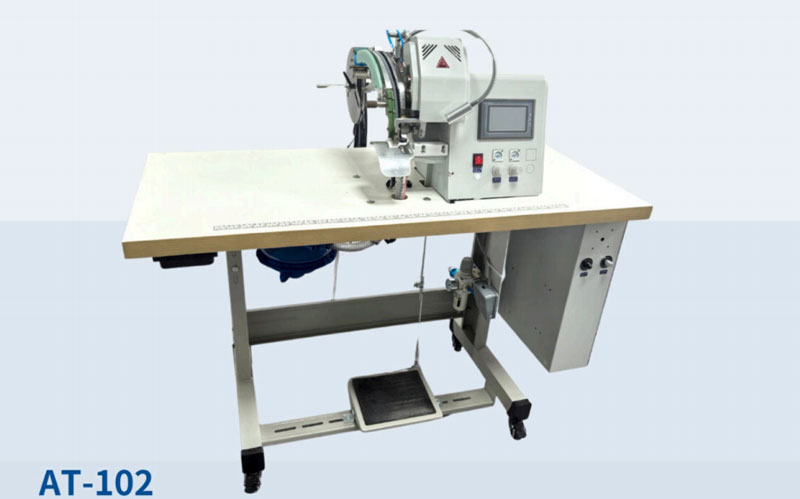
The AT-102 Lace Applying Machine, for example, has an adjustable speed range of 0–150 mm/s. This allows the operator to select an appropriate processing speed rather than running every material at one fixed speed.
Lower speeds may be useful when working with delicate fabrics or when precise positioning is more important than output volume. Higher speeds can be considered when the material is stable and the production process allows faster continuous operation.
Adjustable speed can also help manufacturers manage different orders on the same machine. A factory producing both delicate intimate apparel and more robust outerwear may need different operating conditions for each product.
Therefore, when comparing machines, manufacturers should look for adjustable operating ranges rather than evaluating equipment only by its maximum speed.
4. Pay Attention to the Feeding System
Material feeding directly affects production stability.
An upper and lower roller feeding structure helps guide the fabric through the processing area. Stable feeding can reduce unnecessary movement and help maintain the intended position of the lace and fabric during continuous operation.
This becomes particularly important when working with:
- Stretch fabrics
- Lightweight textiles
- Multi-layer materials
- Narrow lace
- Long continuous bonding areas
- Materials requiring accurate edge positioning
A feeding system should not simply move the fabric forward. It should do so in a controlled and repeatable way.
For production managers, this means the feeding mechanism should be considered alongside adhesive performance. Even a high-quality adhesive process can produce inconsistent results if the fabric moves unpredictably during bonding.
5. Check the Power Requirements Before Installation
Electrical requirements are easy to overlook during equipment purchasing, especially when machines are imported into another country.
The AT-102 model uses single-phase AC/220V input power and has a rated power of 2000W. Manufacturers should confirm that the available electrical infrastructure is compatible with the equipment before installation.
The factory should also consider:
- Available voltage
- Electrical safety requirements
- Machine installation area
- Cable arrangement
- Ventilation conditions
- Distance from other production equipment
Checking these details before shipment can prevent unnecessary installation delays.
For international buyers, it is also useful to confirm the local power standard and whether additional electrical equipment or adaptation is required.
6. Check the Compressed Air Requirement
Some bonding equipment requires compressed air as part of the operating process. This makes the air supply an important part of the factory preparation process.
The AT-102 requires 0.5 MPa compressed air pressure. Buyers should make sure that their existing air system can provide the required pressure consistently.
A suitable air supply helps prevent interruptions caused by unstable operating conditions. Before installation, the production facility should therefore check the available compressor system, air piping, pressure stability, and connection requirements.
This is particularly important for factories introducing automated equipment into an existing production line. A machine may meet the production requirements on paper, but the overall installation can still be affected if supporting utilities are insufficient.
7. Think About Machine Size and Factory Layout
Production equipment needs to fit into the actual working environment.
The AT-102 has a packing size of 133 × 66 × 138 cm, with a net weight of 100 kg and a gross weight of 160 kg. These figures are relevant not only for transportation but also for factory planning.
Before purchasing, manufacturers should determine:
- Where the machine will be installed
- How operators will access it
- Where fabric rolls or workpieces will be placed
- How finished products will be collected
- Whether there is enough maintenance space
- How the machine will enter the factory
A machine should not be evaluated only according to its working footprint. Space for operation, maintenance, material handling, and safe movement should also be considered.
For overseas buyers, packing dimensions and gross weight are additionally important for shipping arrangements and logistics cost calculations.
8. Match the Machine to Production Volume
A small garment workshop and a large-scale apparel factory may need very different equipment strategies.
For smaller manufacturers, flexibility and easy operation may be more important than maximum production speed. They may process different garment styles in relatively small batches and need to change production parameters frequently.
High-volume manufacturers, on the other hand, may prioritize stable continuous operation, repeatability, and integration into an established production workflow.
A Lace Applying Machine with adjustable speed and stable feeding can provide a useful balance between these requirements. The same equipment can potentially be configured for different materials and production orders rather than being limited to one specific garment style.
When calculating machine capacity, buyers should consider actual production conditions rather than theoretical maximum output.
9. Consider Operator Requirements
Even automated equipment still depends on proper setup and operation.
Operators need to understand how the fabric and lace should be positioned, how the machine should be adjusted, and how different materials respond to the bonding process.
A practical training process should cover:
- Material loading
- Lace positioning
- Roller adjustment
- Speed selection
- Adhesive-related settings
- Compressed air requirements
- Routine cleaning
- Basic troubleshooting
- Safe machine operation
Clear operating procedures can help reduce material waste during production startup and improve consistency between different operators.
For factories with multiple shifts, standardized operating procedures are especially useful because they help maintain similar machine settings throughout the working day.
10. Evaluate Maintenance and Long-Term Reliability
The purchase price is only one part of the total cost of owning a Lace Applying Machine.
Manufacturers should also consider routine maintenance, spare parts, technical support, cleaning requirements, downtime, and expected service life.
A machine used in continuous garment production should be easy to inspect and maintain. Operators should be able to identify common problems before they develop into major production interruptions.
Regular maintenance may include checking the feeding rollers, cleaning adhesive-related components, inspecting pneumatic connections, and keeping the working area free from accumulated material.
Reliable maintenance procedures can help maintain consistent production quality over time.
11. Ask for a Production Test Before Ordering
A production test can be one of the most useful steps when purchasing a lace application machine.
Instead of evaluating the machine only from specifications, manufacturers can provide actual fabric and lace samples for testing. The supplier can then demonstrate how the equipment handles the selected materials and bonding requirements.
A useful test should examine:
- Lace alignment
- Bonding consistency
- Material feeding
- Edge quality
- Adhesive distribution
- Processing speed
- Finished appearance
- Repeatability
This approach gives buyers more practical information than a simple equipment catalogue.
It is especially valuable when the intended materials are highly elastic, delicate, multilayered, or technically coated.
12. Why the AT-102 Can Be Considered for Flexible Garment Production
The AT-102 Lace Applying Machine combines an upper and lower roller feeding structure with adjustable processing speed from 0 to 150 mm/s. Its 2000W power, 220V single-phase input, and 0.5 MPa compressed air requirement make its operating conditions clear for factory planning.
The machine is designed for applications including seamless underwear, outdoor apparel, technical garments, and clothing requiring decorative or exposed bonding effects.
Its relatively compact packing dimensions also make transportation and installation planning more straightforward for international garment manufacturers.
More importantly, the machine provides adjustable operating conditions rather than forcing manufacturers to use a single fixed production setting. This can be useful for factories handling multiple garment styles and different material combinations.
13. Questions to Ask a Supplier Before Buying
Before placing an order, buyers should prepare a list of practical questions for the equipment supplier.
Important questions include:
- What fabric types can the machine process?
- What lace widths and structures are suitable?
- What adhesive or bonding materials are recommended?
- Can the machine process elastic fabrics?
- What is the actual working speed for the buyer’s materials?
- What electrical connection is required?
- What compressed air pressure is necessary?
- What routine maintenance is required?
- Are spare parts available?
- Can the supplier conduct a material sample test?
- What training is provided?
- What are the shipping dimensions and gross weight?
These questions can help buyers compare machines according to actual production requirements rather than relying only on catalogue specifications.
Conclusion
Selecting a Lace Applying Machine is ultimately about matching equipment performance with the real conditions of garment production. Fabric characteristics, lace structure, bonding style, production volume, feeding stability, speed adjustment, power supply, compressed air, factory space, and maintenance requirements should all be considered before making a purchasing decision.
For manufacturers that process multiple garment categories, adjustable equipment can provide greater flexibility than a machine designed for only one application. Sample testing is also highly recommended because actual bonding performance depends on the combination of fabric, lace, adhesive, pressure, and processing conditions.
With the right equipment and appropriate operating parameters, automated lace application can become a more consistent and manageable part of modern garment production. For manufacturers evaluating equipment for seamless apparel, outerwear, decorative garments, or technical textiles, the AT-102 Lace Applying Machine from Alster provides a practical option to consider based on its adjustable speed, upper and lower roller feeding, 2000W power configuration, and 0.5 MPa compressed air requirement.