
Modern manufacturing increasingly requires bonding and forming equipment that can handle products with curved surfaces. Traditional flat heat presses work well when two materials can be placed on a flat working table, but many textile and garment components have three-dimensional or curved structures. Applying uniform heat and pressure to these products can therefore be challenging. A Curve Hot Press Machine provides a specialized solution by applying controlled heat and pressure to curved surfaces for bonding, pressing, and shaping applications.
The main purpose of a Curve Hot Press Machine is to combine temperature, pressure, and controlled heating time to create a stable bonding or forming result on products that are not completely flat. This makes the equipment particularly useful for textile processing, garment manufacturing, seamless apparel production, and other applications where curved components need to be processed accurately.
The AT-H185, for example, is designed specifically for curved surface pressing, thermal bonding, and shaping. Its temperature can be adjusted from 0 to 220°C, while the heating time can be set from 2 to 999 seconds. It uses single-phase 220V power and has a working air pressure of 0.5 MPa.
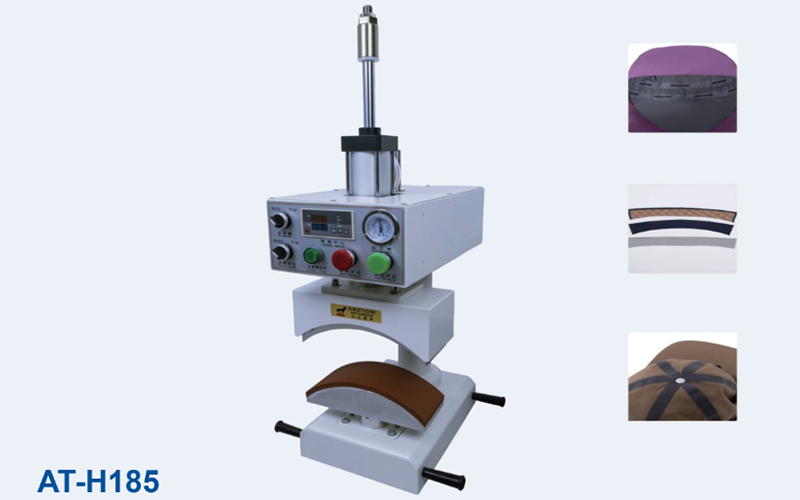
What Is a Curve Hot Press Machine?
A Curve Hot Press Machine is a specialized heat pressing device designed to process materials with curved or shaped surfaces. Instead of relying only on a flat pressing plate, the equipment uses a curved working structure that allows heat and pressure to be applied to products with specific contours.
The basic working principle is relatively straightforward. Materials are positioned on the appropriate working area, and the machine applies controlled heat and pressure for a preset period. When hot melt adhesive film or another heat-activated bonding material is used, the heat softens or activates the adhesive. Pressure then helps bring the materials into close contact. After the bonding cycle is completed, the adhesive cools and forms the required connection.
This process can be used for bonding, reinforcement, shaping, lamination, and other thermal processing operations.
1. Applying Heat and Pressure to Curved Surfaces
The most important function of a Curve Hot Press Machine is its ability to process curved products.
Flat heat pressing equipment is designed primarily around planar surfaces. When a product has a curved structure, achieving consistent contact across the entire bonding area can become more difficult. Gaps or uneven pressure may result in inconsistent bonding.
A curved pressing structure is designed to better match the shape of the workpiece. This allows heat and pressure to be concentrated on the intended processing area.
For garment manufacturers, this is particularly useful when working with shaped textile components, curved seams, molded sections, and other products that cannot be conveniently processed on a completely flat surface.
2. Supporting Thermal Bonding
Another major function is thermal bonding.
In modern textile manufacturing, hot melt adhesive films are increasingly used to connect different materials. Depending on the adhesive formulation, films may be used with polyester, nylon, cotton blends, elastic fabrics, and other textile materials.
The Curve Hot Press Machine provides the controlled processing conditions required to activate the adhesive film. The operator can adjust temperature and heating time according to the material and bonding requirements.
When the correct combination of adhesive film, temperature, pressure, and time is selected, the machine can create a consistent bonded connection without relying entirely on traditional sewing or liquid adhesive application.
This makes the technology relevant to seamless apparel and other modern bonding processes.
3. Improving Bonding Consistency
Consistency is an important consideration in industrial production. When bonding is performed manually, differences in heating time, pressure, temperature, and operator technique can affect the result.
A Curve Hot Press Machine helps standardize these processing parameters.
Temperature control allows operators to establish a defined heating condition. Adjustable time control allows the machine to maintain the selected heating cycle for different applications.
The AT-H185, for example, provides temperature control from 0 to 220°C and heating-time adjustment from 2 to 999 seconds. These settings allow manufacturers to establish different process parameters according to the materials being processed.
Standardized processing can be especially useful when manufacturers need to produce large quantities of similar products.
4. Supporting Seamless Garment Production
The development of seamless clothing has increased the demand for alternative textile joining technologies.
Traditional garment manufacturing commonly relies on sewing to connect fabric components. While sewing remains essential for many applications, some garments require smoother connections, reduced seam bulk, and a cleaner appearance.
Heat bonding provides another method for joining textile components. A hot melt adhesive film can be placed between suitable materials, and the Curve Hot Press Machine can then apply controlled heat and pressure.
This approach can be used in selected areas of sportswear, underwear, functional clothing, and other seamless or partially seamless garments.
5. Helping Process Shaped Textile Components
Textile products are not always flat. Garment components may follow the contours of the human body or contain shaped sections designed for comfort and performance.
A curved pressing system makes it easier to process these components without forcing them into an unsuitable flat configuration.
This is particularly valuable when manufacturers need to bond reinforcement pieces, functional layers, tapes, patches, or other components onto shaped textile products.
By maintaining contact with the curved workpiece, the machine can help improve processing stability and reduce problems associated with unsuitable pressing geometry.
6. Supporting Fabric Lamination
A Curve Hot Press Machine can also play a role in textile lamination.
Lamination involves joining two or more layers to create a composite textile structure. The layers may have different functions, such as providing strength, comfort, elasticity, protection, or appearance.
Hot melt adhesive film can be placed between the layers before the pressing process. Heat activates the adhesive while pressure brings the layers together.
For curved textile components, a curved hot press can provide a more suitable processing method than a conventional flat press.
This can be useful in applications where the finished product needs to maintain a particular shape while the layers remain securely bonded.
7. Supporting Logo, Patch, and Component Bonding
Heat pressing is also commonly associated with attaching textile components such as patches, labels, graphics, and reinforcement pieces.
A curved pressing machine can provide an advantage when the target product has a non-flat surface.
For example, a manufacturer may need to attach a component to a shaped garment section. Instead of placing the component on a completely flat surface and attempting to maintain contact manually, a curved pressing system can provide a more appropriate pressing geometry.
The exact application depends on the adhesive material, substrate, component design, and required bonding strength.
8. Providing Adjustable Processing Conditions
Different materials require different processing conditions. A lightweight textile may require a different temperature and heating time from a thicker multilayer material.
This is why adjustable machine parameters are important.
The AT-H185 provides both temperature and heating-time control, allowing manufacturers to adjust the process according to the application. Its compact design also makes it suitable for production environments where available workspace is limited.
Flexible settings make the machine more adaptable to different production tasks rather than limiting it to one specific material or product.
9. Improving Production Efficiency
Production efficiency is another important role of a Curve Hot Press Machine.
An intuitive control interface allows operators to establish processing parameters without complicated procedures. Once the correct settings have been determined, the same process can be repeated for subsequent products.
The AT-H185 is described as having a simple operating interface and fast production setup, which can reduce operator learning requirements and support a more efficient workflow.
For manufacturers producing repeated batches, process standardization can help reduce unnecessary adjustments between individual pieces.
10. Compact Equipment for Factory Production
Industrial equipment needs to provide useful processing functions without unnecessarily occupying production space.
The AT-H185 has a machine size of approximately 410 × 500 × 810 mm and a net weight of 47 kg. This relatively compact structure can make it easier to integrate into different production environments.
A compact machine can be particularly useful for textile workshops, garment factories, sampling departments, and production lines where floor space must be managed efficiently.
11. Customizing the Pressing Area
Different products may have different dimensions and shapes. A machine designed for only one fixed configuration may not meet every manufacturer’s requirements.
The product information for the AT-H185 indicates that optional sizes and customized configurations can be provided according to production requirements.
This flexibility allows manufacturers to consider the dimensions, shape, and processing requirements of their products when selecting equipment.
Customization can be especially valuable for companies producing specialized garment components or products with non-standard curved structures.
12. Applications Beyond Clothing
Although garment and textile production are important applications, a Curve Hot Press Machine is not necessarily limited to clothing.
Any manufacturing process involving suitable heat-activated materials and curved surfaces may potentially benefit from this type of equipment.
Its applications can include textile components, shaped fabric products, bonding processes, and other customized production tasks. The actual suitability depends on the material, adhesive, product geometry, and required processing conditions.
How to Select a Curve Hot Press Machine
Before purchasing a Curve Hot Press Machine, manufacturers should evaluate several factors.
First, consider the shape and dimensions of the products that need to be processed. The working area should match the target application.
Second, consider the temperature requirements of the adhesive and materials. The machine must provide a suitable temperature range without damaging the textile.
Third, evaluate the required heating time and pressure. Different materials may require different combinations of processing parameters.
Finally, manufacturers should consider operation, machine footprint, customization options, production volume, and technical support.
Conclusion
The primary role of a Curve Hot Press Machine is to provide controlled heat and pressure for bonding, pressing, and shaping products with curved surfaces. Compared with conventional flat pressing equipment, its specialized configuration makes it more suitable for applications where product geometry is an important consideration.
In garment and textile manufacturing, the machine can support thermal bonding, seamless apparel production, fabric lamination, component attachment, reinforcement, and shaped textile processing.
With adjustable temperature and heating time, simple operation, compact construction, and customizable configurations, a Curve Hot Press Machine can provide manufacturers with a flexible solution for modern curved-surface processing. When the machine parameters are properly matched with the adhesive, fabric, product structure, and production requirements, it can help create consistent processing results while supporting more efficient manufacturing workflows.