
Fabric processing is becoming increasingly sophisticated as clothing manufacturers develop garments that are lighter, more flexible, more comfortable, and more functional. Traditional sewing remains an important manufacturing method, but many modern textile products also require bonding, lamination, reinforcement, and seamless construction. When these operations involve curved or shaped fabric components, conventional flat pressing equipment may not provide the required processing conditions.
A Curve Hot Press Machine for Fabric is designed to address this type of production requirement. By combining controlled heat and pressure with a curved pressing structure, the machine can process fabric components that have non-flat surfaces. It can be used for thermal bonding, fabric lamination, reinforcement, component attachment, and other heat-activated textile applications.
The AT-H185 Curve Hot Press Machine is specifically described for curved surface pressing, thermal bonding, and shaping in textile and garment manufacturing. It offers a temperature range of 0–220°C, heating time from 2–999 seconds, and a working air pressure of 0.5 MPa.
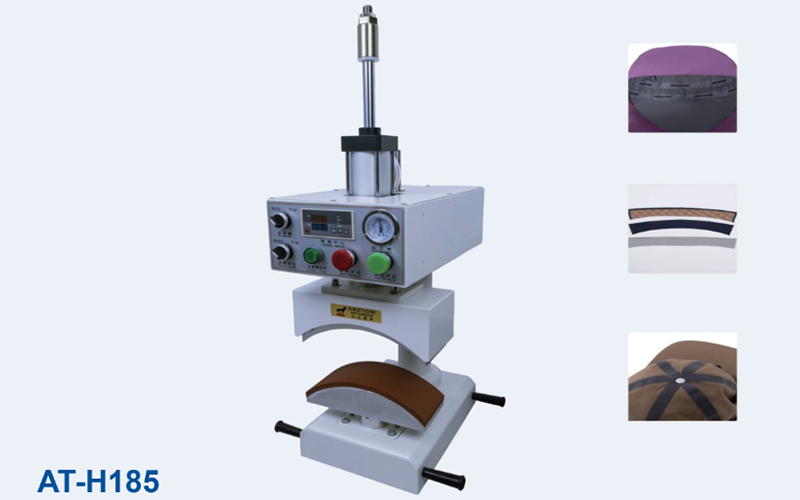
What Is a Curve Hot Press Machine for Fabric?
A Curve Hot Press Machine for Fabric is specialized heat pressing equipment developed for textile materials and shaped fabric products.
The basic process involves placing a fabric component and a bonding material in the correct position before applying heat and pressure. When a hot melt adhesive film is used, heat activates the adhesive, while pressure helps the materials form close contact. Once the bonding cycle is completed, the adhesive cools and creates the required connection.
The curved pressing structure is particularly important when the fabric follows a three-dimensional shape. Instead of forcing the material to remain completely flat, the machine is designed to accommodate a curved processing surface.
This makes the equipment relevant to modern garment production, especially where smooth construction and controlled textile bonding are required.
1. Bonding Curved Fabric Components
The primary function of a Curve Hot Press Machine for Fabric is to apply controlled heat and pressure to shaped textile components.
Garments often contain curved areas that follow the contours of the body. Sleeves, waist sections, underwear components, sportswear panels, and other textile structures may not be suitable for conventional flat pressing.
A curved pressing machine allows the manufacturer to position these components on an appropriate working surface. The heating and pressing process can then be carried out according to the selected parameters.
This helps manufacturers integrate thermal bonding into products that would otherwise be difficult to process using standard flat equipment.
2. Supporting Seamless Garment Manufacturing
Seamless apparel is an important application for textile bonding technology.
Traditional stitching can create raised seams, needle holes, and additional material layers. For garments worn directly against the skin, manufacturers may want to minimize bulky seam structures.
Hot melt adhesive film provides an alternative way of joining compatible textile materials. When combined with a Curve Hot Press Machine for Fabric, the bonding process can be applied to shaped garment components.
This can be useful for sportswear, underwear, compression clothing, activewear, and other products where flexibility and smooth construction are important.
Alster’s product information specifically lists seamless apparel production as an application area for the AT-H185.
3. Applying Hot Melt Adhesive Film
Hot melt adhesive film is an important material used together with fabric bonding equipment.
Unlike liquid adhesive, a hot melt film is supplied as a pre-formed solid layer. It can be cut to the required shape and positioned between textile components.
During pressing, the machine provides heat that activates the adhesive. Pressure then helps establish contact between the film and the materials.
The appropriate film must be selected according to the fabric and application. Alster’s product range includes TPU, TPE, EVA, PES, PO, and PA hot melt adhesive films, which have different material characteristics and application requirements.
The machine and adhesive therefore need to be considered together rather than as completely independent components.
4. Improving Fabric Bonding Consistency
One challenge in manual textile bonding is maintaining consistent temperature, pressure, and heating time.
If one production cycle receives insufficient heat, the adhesive may not activate properly. If the temperature or processing time is excessive, the fabric or adhesive may be affected.
A Curve Hot Press Machine for Fabric allows manufacturers to establish defined processing parameters.
The AT-H185 provides adjustable temperature and heating-time controls, allowing operators to set processing conditions according to different materials and applications.
Once an appropriate process has been tested, the same settings can be used repeatedly to support more consistent production.
5. Fabric Lamination on Curved Structures
Fabric lamination involves joining multiple material layers into one composite structure.
For example, a garment may combine an outer textile, functional layer, lining, mesh, or other material. Adhesive film can be positioned between the layers and activated through heat pressing.
When the laminated component has a curved shape, a curved press can provide a more appropriate processing method than a conventional flat machine.
This can be useful for functional clothing and other garments that contain shaped multilayer structures.
The final result depends on adhesive selection, fabric compatibility, temperature, pressure, heating time, and cooling conditions.
6. Supporting Sportswear Production
Sportswear places special demands on textile construction because garments must accommodate repeated movement.
Running, cycling, stretching, training, and other activities can place continuous stress on fabric connections. Heavy seams or rigid bonded areas may affect comfort and flexibility.
A Curve Hot Press Machine for Fabric can support bonding processes that reduce the need for bulky stitched connections in suitable applications.
It can also be used to attach reinforcement components or combine textile layers in shaped areas.
Because different sportswear materials have different thermal and mechanical characteristics, manufacturers should test the selected adhesive and processing conditions before mass production.
7. Helping Create Smooth Garment Structures
Appearance is another important consideration in modern clothing.
Consumers often expect sportswear and functional apparel to have clean surfaces and minimal visible construction details.
Heat bonding can help manufacturers create low-profile connections in selected applications. Instead of relying exclusively on visible stitching, adhesive film can join compatible textile components.
A curved press is particularly useful when the connection is located on a shaped section of the garment.
This can help manufacturers explore more flexible garment construction methods while maintaining the intended shape of the textile product.
8. Attaching Patches, Labels, and Reinforcement Components
A Curve Hot Press Machine for Fabric can also support the attachment of certain textile components.
Patches, reinforcement pieces, labels, decorative elements, and functional textile components may need to be bonded to garment surfaces.
When the target area is curved, maintaining consistent contact can be difficult with a conventional flat press.
A curved pressing structure can make the process more suitable for shaped garment sections. The specific bonding method should be selected according to the component and the fabric.
9. Supporting Different Fabric Types
Modern garments use a wide variety of textile materials.
Common examples include polyester, nylon, cotton blends, elastic fabrics, mesh, and multilayer functional textiles. Different materials respond differently to heat and pressure.
Alster’s product information indicates that hot melt adhesive films can be used with materials including polyester, nylon, and cotton blended fabrics, while the appropriate film should be selected according to the specific application.
This means manufacturers should not use one universal processing formula for every fabric.
Instead, the bonding temperature, pressure, heating time, adhesive type, and film thickness should be evaluated according to the material combination.
10. Providing Adjustable Temperature and Time
Temperature and heating time are two of the most important parameters in fabric bonding.
The adhesive must reach a suitable activation condition, while the fabric needs to remain within an acceptable thermal range.
The AT-H185 provides a temperature range of 0–220°C and a heating time range of 2–999 seconds.
This adjustment range gives manufacturers flexibility when developing different bonding processes.
However, the maximum machine settings should not automatically be treated as recommended production settings. The actual temperature and time should be determined through material and adhesive testing.
11. Supporting Efficient Garment Production
A Curve Hot Press Machine for Fabric can also contribute to production efficiency.
The AT-H185 is designed with a simple operating interface and adjustable processing parameters. According to the product information, its operation is intended to reduce training requirements and support fast production setup.
For garment factories, this can be useful when multiple operators need to perform similar bonding tasks.
Once the correct parameters have been established, production can follow a more standardized workflow.
12. Compact Design for Textile Factories
Factory space is another practical consideration.
The AT-H185 has a machine size of approximately 410 × 500 × 810 mm, with a net weight of 47 kg.
Its compact structure can make it suitable for production workshops, sampling departments, textile processing areas, and garment factories where equipment footprint matters.
The product also supports optional sizes and customized configurations, allowing manufacturers to consider specific production requirements.
How to Use a Curve Hot Press Machine for Fabric Effectively
To achieve stable bonding results, manufacturers should begin by identifying the fabric combination and adhesive type.
Next, the operator should determine suitable temperature, pressure, and heating time through testing. The fabric should be positioned correctly, and the adhesive film should cover the intended bonding area without unnecessary overlap.
After pressing, the bonded area should be inspected for adhesion, appearance, flexibility, and dimensional stability.
For garments that will undergo washing, stretching, or repeated use, additional durability testing is recommended before full-scale production.
Conclusion
The main role of a Curve Hot Press Machine for Fabric is to provide controlled heat and pressure for bonding, lamination, reinforcement, and shaping of curved textile components.
In garment manufacturing, it can support seamless apparel production, sportswear, underwear, functional clothing, fabric lamination, and other applications where conventional flat pressing equipment may be less suitable.
By combining an appropriate hot melt adhesive film with controlled temperature, pressure, and heating time, manufacturers can develop more consistent fabric bonding processes. The curved pressing structure also makes the equipment suitable for textile components that follow three-dimensional shapes.
For manufacturers looking to introduce heat bonding into modern garment production, a Curve Hot Press Machine for Fabric provides a practical processing option for moving beyond purely flat pressing and supporting more advanced textile construction.