
The seamless garment industry has experienced rapid growth in recent years due to increasing consumer demand for comfortable, lightweight, and functional apparel. Products such as seamless underwear, sportswear, yoga wear, compression garments, and performance clothing require advanced manufacturing technologies to achieve smooth appearance, excellent elasticity, and superior wearing comfort.
Unlike traditional garment production methods that rely heavily on stitching, seamless garment manufacturing uses bonding, lamination, and heat fusion technologies to join fabric components without visible seams. In this process, adhesive films, TPU films, hot melt adhesives, and functional textile layers need to be accurately bonded under controlled temperature and pressure conditions.
A Continuious Fusing Machine plays an essential role in this manufacturing process. It provides continuous heating, controlled pressure, and stable bonding performance, helping manufacturers achieve strong adhesion, clean finishing, and high production efficiency. Especially in seamless garment production, this type of equipment has become a key solution for bonding fabrics, elastic materials, adhesive films, and functional textile components.
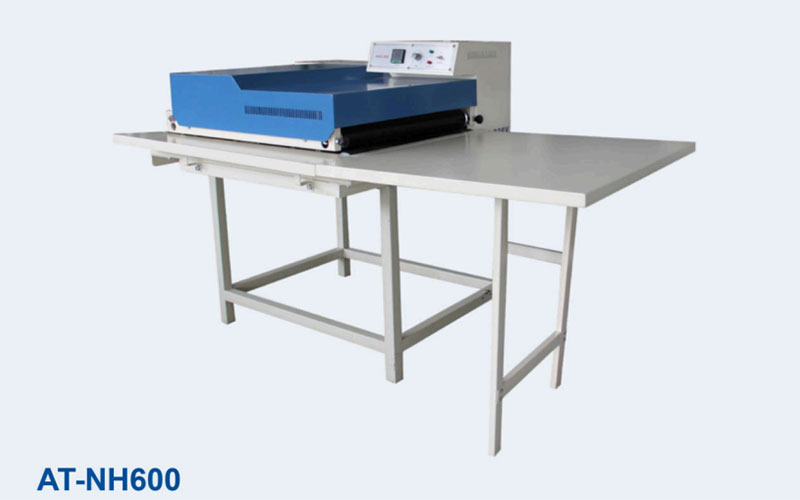
The AT-NH600 Continuious Fusing Machine is designed for modern garment manufacturers requiring reliable and efficient fabric bonding solutions. With a compact structure, 600mm bonding width, automatic belt deviation adjustment, precise temperature control, and stable pressure performance, it is suitable for various seamless garment applications.
What Is a Continuious Fusing Machine?
A Continuious Fusing Machine is an industrial textile bonding machine that uses heat and pressure to fuse different layers of materials together continuously. It is commonly used for bonding fabrics with interlining, adhesive films, TPU materials, and other functional textile components.
Unlike traditional manual pressing methods, continuous fusing machines allow materials to pass through a heated conveyor system where temperature, pressure, and bonding time can be accurately controlled.
The main working process includes:
- Fabric and adhesive material preparation
- Material feeding into the conveyor system
- Controlled heating and pressure application
- Adhesive melting and penetration
- Cooling and solidification
- Continuous output of bonded materials
This automated process improves production efficiency while ensuring consistent bonding quality.
The Importance of Fusing Technology in Seamless Garment Production
Seamless garments require extremely high standards for comfort, flexibility, and appearance. Traditional sewing methods can create pressure points, visible seams, and reduced elasticity. To overcome these limitations, manufacturers increasingly use bonding technologies.
Fusing technology provides several important advantages:
- Creates smooth and invisible connections
- Maintains fabric elasticity
- Improves wearing comfort
- Reduces production steps
- Enhances waterproof and windproof performance
- Supports lightweight garment design
In seamless garment manufacturing, the bonding quality directly affects product durability and user experience. Poor temperature control or uneven pressure may result in weak adhesion, adhesive overflow, or fabric damage. Therefore, advanced fusing equipment is essential.
Applications of Continuious Fusing Machine in Seamless Garment Manufacturing
1. Seamless Underwear Production
One of the most important applications of a Continuious Fusing Machine is seamless underwear manufacturing.
Seamless bras, panties, and shaping underwear require smooth edges and flexible bonding between different textile layers. Traditional stitching may create discomfort when worn directly against the skin. Heat fusion technology provides a softer and cleaner alternative.
The machine can be used for bonding:
- Elastic fabric layers
- Functional textile panels
- Decorative elements
- Reinforcement areas
- Adhesive films
The AT-NH600 provides stable pressure and temperature control, helping manufacturers achieve reliable bonding results for high-end seamless underwear products.
2. Seamless Sportswear and Yoga Wear
Sportswear manufacturers require garments that provide flexibility, durability, and comfort during movement. Seamless bonding technology is widely used in yoga pants, leggings, compression shirts, and athletic apparel.
A Continuious Fusing Machine helps bond:
- Stretch fabrics
- TPU adhesive films
- Reinforcement strips
- Functional layers
Compared with traditional sewing, bonded sportswear offers smoother surfaces and improved elasticity. This makes it especially suitable for products requiring close body contact and high movement flexibility.
3. TPU Film and Adhesive Film Lamination
TPU films and hot melt adhesive films are widely used in seamless garment production because they provide strong bonding performance while maintaining fabric flexibility.
Continuous fusing machines ensure that adhesive films receive uniform heating during lamination. Uneven heating can lead to incomplete bonding or inconsistent product quality.
The AT-NH600 features:
- Electronic temperature control
- Special heating aluminum plate
- Stable pressure mechanism
- Bonding width up to 600mm
These features help manufacturers achieve consistent TPU and adhesive film bonding performance.
4. Functional Apparel Manufacturing
Modern functional garments often include multiple layers designed for specific performance requirements. Examples include:
- Waterproof jackets
- Outdoor clothing
- Medical compression garments
- Protective clothing
These products require reliable bonding between fabrics and functional membranes.
Continuous fusing technology allows manufacturers to combine different materials while maintaining:
- Breathability
- Flexibility
- Durability
- Lightweight construction
This makes fusing machines valuable equipment for technical textile production.
5. Fabric Reinforcement and Edge Bonding
In seamless garment production, some areas require additional reinforcement to improve strength and durability.
A Continuious Fusing Machine can apply adhesive layers to:
- Waistbands
- Armholes
- Necklines
- Decorative edges
- High-stress areas
The controlled pressure system ensures that reinforcement materials are firmly attached without damaging delicate fabrics.
Key Features of AT-NH600 Continuious Fusing Machine
Compact and Flexible Design
The AT-NH600 features a compact structure that makes it easy to move and install in different production environments. This is especially beneficial for small and medium-sized garment factories that need flexible production solutions.
Its side-open design allows processing of larger fabric pieces and various garment components, including connected sleeve pieces and oversized textile sections.
Stable Pressure Control
Bonding quality depends heavily on pressure consistency. The AT-NH600 is equipped with a specially designed pressure assistance system that provides strong pressure performance.
With maximum pressure capability up to 2kg/cm², it ensures sufficient contact between fabrics and adhesive materials, improving bonding strength.
Precise Temperature Management
Temperature control is one of the most important factors in fabric bonding.
The machine uses:
- Electronic thermostat control
- Special heating aluminum plate
- Uniform heating structure
These systems reduce temperature differences and help maintain stable bonding conditions.
Accurate thermal control prevents common problems such as:
- Adhesive melting failure
- Fabric damage
- Uneven bonding strength
- Surface deformation
Automatic Belt Deviation Adjustment
During continuous operation, conveyor belt alignment is critical for stable production.
The AT-NH600 includes an automatic deviation adjustment function that helps maintain belt positioning, reducing interruptions and improving operational reliability.
Efficient Continuous Production
Unlike manual heat pressing, continuous fusing machines allow uninterrupted processing.
The AT-NH600 supports adjustable bonding time from 10 to 34 seconds, allowing manufacturers to optimize settings according to different materials.
This improves:
- Production speed
- Product consistency
- Labor efficiency
Advantages of Using Continuious Fusing Machine for Seamless Garments
Improved Product Quality
Stable temperature, pressure, and bonding time ensure consistent results across large production batches. This helps manufacturers maintain high-quality standards for premium seamless garments.
Reduced Labor Requirements
Automation reduces dependence on manual pressing operations. Workers only need to load materials and monitor production, improving overall efficiency.
Better Material Utilization
Precise bonding reduces material waste caused by failed bonding, incorrect alignment, or uneven adhesion.
Higher Production Efficiency
Continuous operation allows factories to process more products within the same working time compared with traditional methods.
Enhanced Product Design Possibilities
With advanced fusing technology, manufacturers can create innovative garment designs that are difficult to achieve through traditional sewing methods.
Technical Specifications of AT-NH600
The AT-NH600 Continuious Fusing Machine is designed with specifications suitable for seamless garment production:
- Voltage: Single-phase 220V
- Motor Power: 40W
- Machine Power: 4200W
- Maximum Pressure: 2kg/cm²
- Temperature Range: 0–200°C
- Bonding Width: 600mm
- Bonding Time: 10–34 seconds
- Net Weight: 120kg
- Gross Weight: 170kg
These parameters provide manufacturers with reliable performance for fabric bonding, adhesive film lamination, and seamless apparel processing.
How to Choose the Right Fusing Machine for Seamless Garment Production?
When selecting a continuous fusing machine, manufacturers should consider several factors:
Material Compatibility
Different fabrics and adhesive films require different temperature and pressure settings. Ensure that the machine supports the required materials.
Bonding Width
Production requirements determine the necessary working width. Larger garments may require wider bonding areas.
Temperature Accuracy
Stable temperature control is essential for protecting sensitive fabrics and achieving strong adhesion.
Pressure Stability
Uniform pressure ensures consistent bonding quality across the entire material surface.
Production Capacity
Factories should choose equipment that matches their production volume and workflow requirements.
Conclusion
The Continuious Fusing Machine has become an important technology in seamless garment manufacturing. By providing precise heating, stable pressure, and continuous bonding capability, it helps manufacturers produce comfortable, durable, and high-quality seamless apparel.
From seamless underwear and sportswear to functional clothing and technical textiles, continuous fusing technology enables more flexible and efficient production methods. The AT-NH600 Continuious Fusing Machine combines compact design, reliable performance, and advanced temperature control to meet the growing demands of modern garment manufacturers.
As the seamless apparel market continues to expand, investing in advanced fusing equipment will help manufacturers improve production efficiency, enhance product quality, and maintain competitiveness in the global textile industry.