
Choosing suitable heat pressing equipment is an important decision for garment manufacturers that process shaped textile components, thermal bonding materials, or products with curved surfaces. The right machine should support the required processing conditions while fitting the production layout, workpiece dimensions, and operating procedures.
However, comparing equipment based only on price, power consumption, or maximum temperature can lead to an unsuitable purchase. A machine may offer an adequate heating range but lack the working area needed for the product. Another model may fit the workpiece but fail to meet the required cycle time or utility conditions.
A systematic selection process helps manufacturers evaluate equipment more accurately, reduce commissioning problems, and make better long-term purchasing decisions.
1. Define the Products You Need to Process
The first step is to identify the intended applications. Garment factories may process fabric assemblies, curved textile components, laminated materials, or parts requiring localized thermal bonding. Each application can have different requirements for contact area, material thickness, temperature, and cycle duration.
Prepare representative samples or technical drawings before comparing machines. Record the dimensions of the component, the radius of the curved section, the bonding area, and any restrictions on the finished appearance.
It is also useful to distinguish between current production requirements and future product plans. A machine selected for one component may not accommodate a larger workpiece or a different curvature without modification.
Manufacturers should discuss these details with the equipment supplier before requesting a quotation. Clear application information helps the supplier determine whether the standard configuration is suitable or whether customized tooling and working dimensions should be considered.
2. Check the Temperature Range and Control Accuracy
Temperature capability is a key specification because thermal bonding depends on the material and adhesive system being processed. The required temperature should come from the relevant material manufacturer’s recommendations and be verified through testing.
When comparing machines, review both the available temperature range and the way the machine controls its heating cycle. A wide adjustment range offers flexibility, but the equipment must also maintain suitable conditions during actual operation.
Do not assume that a higher maximum temperature automatically means better performance. Many textile applications require moderate heating conditions, and excessive heat can cause shrinkage, discoloration, deformation, or adhesive overflow.
Ask the supplier how temperature is measured and controlled, and whether the proposed configuration is appropriate for the intended workpiece. During commissioning, test representative materials and confirm that the selected settings produce acceptable bonding results.
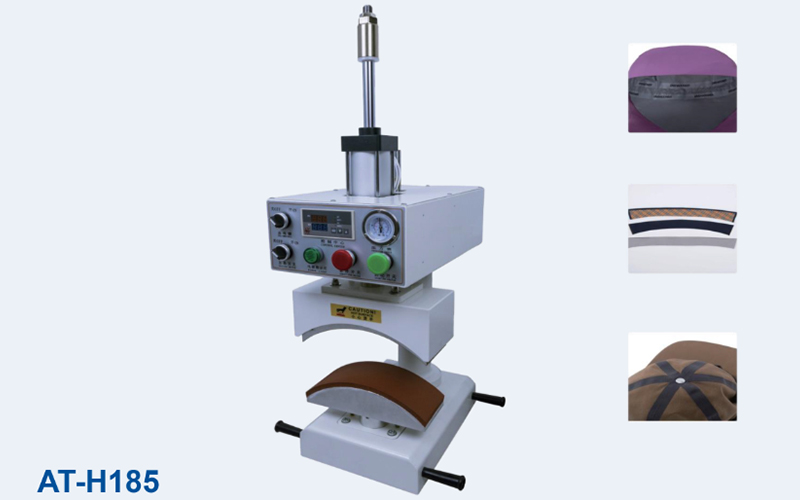
For example, the AT-H185 Curve Hot Press Machine has a specified temperature range of 0–220°C. This gives buyers a reference point for comparing the machine’s heating capability with their process requirements. The actual operating setting must still be established through material-specific testing.
3. Evaluate the Heating Time Range
Heating time determines how long the workpiece remains in the heating cycle. The correct duration depends on the adhesive activation requirements, material thickness, thermal characteristics, and intended bond quality.
A machine with adjustable time settings allows operators to adapt the process to different products. Nevertheless, the time range alone does not establish the achievable production output. Loading, positioning, pressing, cooling, inspection, and unloading may all contribute to the complete cycle.
Estimate the expected production rate using the full operating sequence rather than the heating period alone. If the machine will process several product types, check whether the time control can accommodate their validated settings conveniently.
The AT-H185 supports a heating time range of 2–999 seconds. Buyers can compare this range with the cycle durations identified during product testing. Where cycle consistency is important, establish standard settings and document them for operators.
4. Confirm the Working Area and Curvature
The working area is especially important when selecting equipment for curved products. A machine may provide enough overall space for a component but still fail to accommodate the shape, orientation, or bonding zone required by the production process.
Check the complete dimensions of the workpiece, including any protruding sections that could interfere with loading or pressing. Confirm the curve radius and determine whether the machine’s tooling or pressing configuration can make appropriate contact with the surface.
The AT-H185 lists its working area as 250 × 100 × R185 × 70. Because this notation includes a radius designation, buyers should confirm the drawing and dimensional interpretation with the supplier before determining compatibility.
If several product designs will share the same machine, evaluate each design individually. Different curves or material thicknesses may require separate fixtures or adjustments. Customization may be worth considering when the standard working configuration does not meet the production requirements.
5. Verify Electrical and Pneumatic Requirements
Utility compatibility should be checked before a purchase order is confirmed. Electrical supply, machine power, air pressure, installation conditions, and local safety requirements can all influence commissioning.
The AT-H185 is specified for single-phase 220V power and has a machine power rating of 950W. Its listed working air pressure is 0.5 MPa.
These figures should be compared with the factory’s available electrical and compressed-air systems. Buyers should also confirm connector requirements, air quality recommendations, installation instructions, and any additional utility requirements with the supplier.
Do not select equipment based on voltage alone. The electrical connection must comply with local regulations, and the pneumatic supply must be able to meet the machine’s specified operating conditions. Installation and maintenance should be carried out by appropriately qualified personnel.
6. Consider Machine Size and Factory Layout
The physical dimensions of a machine affect more than floor-space planning. Operators need sufficient access to load workpieces, adjust settings, inspect finished components, and perform routine maintenance.
The listed dimensions of the AT-H185 are 410 × 500 × 810 mm. Its net weight is 47 kg, and its gross weight is 55 kg. The packing dimensions are 530 × 600 × 910 mm.
Use the machine dimensions to estimate installation space, but allow additional room for operation and servicing. Confirm the access requirements, table or floor support, ventilation conditions, and safe movement of materials around the workstation.
Shipping information is equally relevant for international buyers. Gross weight and packing size can help freight forwarders estimate transport requirements, although the final freight cost also depends on the shipping method, destination, and carrier.
7. Assess Customization and Production Flexibility
Standard machine specifications do not always cover every product requirement. Manufacturers may need different fixtures, working dimensions, or configurations to accommodate a specialized component.
Before requesting customization, provide the supplier with drawings, sample parts, material information, and a description of the intended process. These details allow the supplier to evaluate feasibility and clarify which parts of the equipment can be adapted.
It is also important to understand the commercial implications. Customized configurations may affect production lead time, pricing, validation procedures, and future replacement-part requirements.
A flexible machine is valuable when it supports realistic production needs, not simply because it offers more options. Buyers should prioritize adjustments that improve process compatibility, product quality, or operational efficiency.
8. Compare Ease of Operation and Maintenance
A machine’s operating interface can affect training requirements and production consistency. Clear controls for temperature and heating time help operators follow established settings and reduce unnecessary adjustments.
During equipment evaluation, ask how operators start and stop a cycle, change settings, and respond to abnormal conditions. Confirm the availability of operating instructions and determine what routine inspections are required.
Maintenance planning should cover heating components, pneumatic connections, control systems, and any application-specific tooling. Buyers should also ask about spare parts, technical support, warranty coverage, and troubleshooting procedures.
These considerations are particularly important for factories that do not have a dedicated maintenance team. Accessible documentation and a clear support process can reduce delays when equipment needs attention.
9. Test the Machine Before Finalizing the Purchase
Technical specifications are essential for screening equipment, but they cannot replace application testing. A machine that appears suitable on paper may produce different results when used with a particular adhesive, textile structure, or curved workpiece.
Whenever possible, provide representative samples for evaluation. Define acceptance criteria before testing, including bond strength, visual appearance, dimensional stability, processing time, and repeatability.
Ask for the proposed settings and testing conditions to be documented. If several materials will be processed, test the most demanding or representative combinations rather than relying on a single sample.
The final decision should be based on the machine’s demonstrated suitability for the intended application, together with its technical specifications, installation requirements, service arrangements, and total purchasing cost.
Recommended Equipment for Curved Heat Pressing
For manufacturers looking for compact equipment for curved surface pressing, the AT-H185 Curve Hot Press Machine is one option to evaluate.
The model features a single-phase 220V electrical supply, 950W machine power, a specified working air pressure of 0.5 MPa, a temperature range of 0–220°C, and an adjustable heating time range of 2–999 seconds. Its listed machine dimensions are 410 × 500 × 810 mm.
These specifications make it possible for purchasing teams to conduct an initial compatibility assessment. The next step is to compare the working area and curved geometry with actual product samples and confirm any application-specific requirements with the manufacturer.
Conclusion
Selecting a curve hot press machine requires a complete assessment of the workpiece, temperature and time requirements, working area, utilities, factory layout, customization options, and maintenance arrangements.
By preparing product drawings, defining measurable acceptance criteria, and testing representative materials before purchase, garment manufacturers can make more informed equipment decisions. A machine should be selected because it meets the real processing requirements of the production line, rather than because one specification appears superior to another.
Careful evaluation helps reduce purchasing risk and provides a stronger foundation for consistent thermal bonding and curved surface processing.